The TCM supply chain has operated in roughly the same form for decades: factories produce, distributors aggregate, brands package, clinics buy. The structure has been stable largely because it worked well enough — not because it was the best possible model.
That stability is shifting. Two sets of forces are converging to change what clinics will need from their supply chain over the next several years — and understanding them helps explain why factory-direct sourcing is emerging now rather than earlier.
Force One: Regulatory Pressure Is Increasing
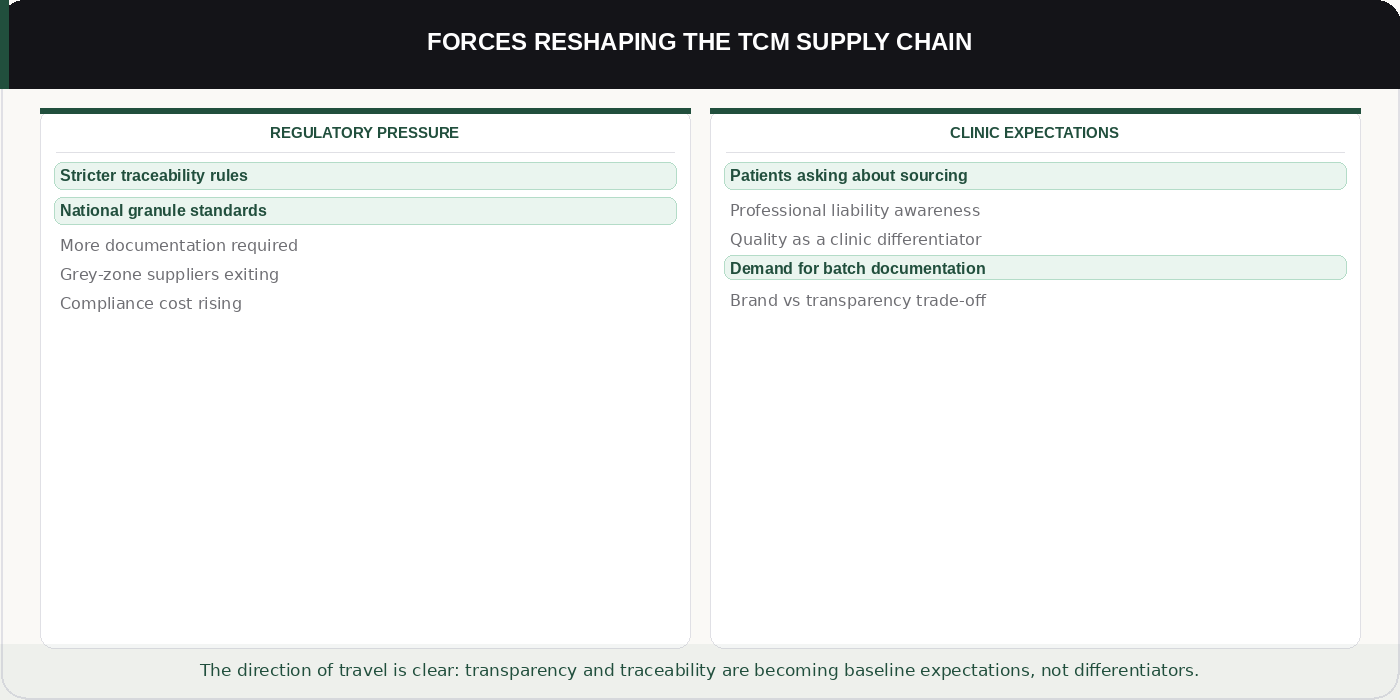
China's regulatory framework for TCM formula granules has been tightening systematically. The national pilot program that started with six enterprises is now a template for industry-wide standardization. Traceability requirements — batch documentation, raw material origin records, production process logs — are becoming baseline expectations rather than premium features.
- Documentation requirements are rising. Regulatory bodies in both China and importing countries are increasingly requiring documentation that proves where a product came from, how it was made, and whether it meets applicable standards. Multi-layer supply chains that can't produce this documentation cleanly are at a structural disadvantage.
- Grey-zone manufacturers are under pressure. As standards tighten, operators who have competed on low price without meeting production quality requirements are finding the regulatory environment less hospitable. The effect over time is a market that skews toward disclosed, certified manufacturers.
- Compliance costs are rising for everyone. Meeting documentation and traceability requirements takes resources. For distributors and repackagers who lack direct relationships with certified manufacturers, meeting these requirements is increasingly difficult. For factory-direct models with disclosed sources, they're already built in.
Force Two: Clinic Expectations Are Evolving
Alongside regulatory pressure, market expectations are shifting from the clinic side. This is happening more gradually, but the direction is consistent.
- Patients are asking sourcing questions. A meaningful and growing segment of TCM patients — particularly in Western markets — are asking where their treatment materials come from. The response "I get it from my supplier" is becoming less satisfying than it once was. Clinics that can answer with specifics — manufacturer name, certification status, batch origin — are positioned differently.
- Professional liability awareness is growing. As TCM practice becomes more integrated into broader healthcare environments, practitioners are increasingly aware of the documentation they may need to produce if a quality issue ever arises. Practices built around undocumented supply chains carry a risk that documented supply chains don't.
- Sourcing quality is becoming a clinic differentiator. In competitive markets, clinics that can demonstrate supply chain transparency are beginning to use it as a practice differentiator — not just a compliance checkbox. This is still early, but the direction is established.
Transparency and traceability are moving from differentiators to baseline expectations. Clinics that build their supply chains around documented, disclosed manufacturers now are positioning themselves ahead of requirements that will likely become standard. Clinics that delay are building a sourcing gap that becomes harder to close as the baseline rises.
Where Factory2Clinic Fits in This Context
Factory2Clinic isn't a response to a trend. It's a model that was always structurally more rational — fewer layers, more transparency, more predictable pricing — that the current environment makes more compelling.
The combination of tightening regulatory requirements, rising documentation expectations, and evolving patient and market standards creates a convergence point: sourcing models that can't demonstrate their supply chain are increasingly at a disadvantage, and sourcing models that disclose their manufacturing source, provide per-batch documentation, and operate under verified production standards are increasingly well-positioned.
This series has covered the mechanics of that model in detail — where the cost advantage comes from, what GMP certification means in practice, when factory-direct is and isn't the right choice, and how to build the planning habits that make it work. The industry context is the backdrop that explains why now is a reasonable time to build those habits, rather than waiting.
Closing the series
The TCM supply chain is moving toward greater transparency and traceability — driven by regulatory requirements from above and by evolving clinic and patient expectations from below. The clinics that navigate this shift well will be those that have already built their sourcing practices around documented, disclosed manufacturers.
Factory2Clinic is one model for doing that. It isn't the only answer, and it isn't right for every purchase. But for planned restocking of core inventory herbs, with a manufacturing partner whose credentials are verifiable and whose batch documentation ships with every order, it's a more rational foundation than the alternative. That's what this series has been about.
Ready to order more clearly?
If your clinic values traceability and planned restocking, Direct2Factory is designed for that workflow.
Start Ordering →