GMP. You've seen the initials on product labels, supplier profiles, and sales materials so many times they've probably stopped meaning much. Like "pharmaceutical-grade" or "quality-assured," the phrase tends to appear as a signal rather than a specific claim.
But behind the label is a set of concrete requirements — and understanding what they actually cover helps explain why QiGlobal's manufacturing partnership is built the way it is, and what that means for the herbs you stock in your clinic.
What GMP Actually Requires
Good Manufacturing Practice is a regulatory framework, not a single certification. In China, pharmaceutical GMP standards are administered by the National Medical Products Administration (NMPA) and cover a defined set of operational requirements across a manufacturing facility:
- Premises and equipment. Production environments must meet physical specifications for cleanliness, air quality, temperature, and contamination control. Equipment must be validated, calibrated, and maintained on documented schedules.
- Raw material controls. Incoming materials must be tested and quarantined before use. Each ingredient batch requires documented origin and quality verification before entering production.
- Process documentation. Every step of the manufacturing process must be captured in writing — not after the fact, but as a concurrent record. Deviations must be logged and investigated.
- Finished product testing. Each batch of finished product is tested against defined specifications before release. Results are retained as permanent records.
- Personnel and training. Staff involved in production must meet defined qualifications and complete documented training on relevant procedures.
What GMP does not guarantee is uniformity across all certified facilities. A facility can meet GMP requirements while still varying considerably in scale, process sophistication, and quality culture. Certification is a floor, not a ceiling.
When evaluating a supplier's GMP claim, the relevant questions aren't just "do they have certification?" but "what does their production environment actually look like, and how long have they operated at this standard?" A facility that has maintained GMP compliance for years under regulatory scrutiny is a meaningfully different proposition from one that recently achieved initial certification.
Neo-Green: Beyond Baseline Certification
QiGlobal Supply works with Sichuan Neo-Green Pharmaceutical Technology Development Co., Ltd. The choice reflects more than GMP compliance — it reflects a specific position within the TCM manufacturing regulatory landscape that is worth understanding directly.
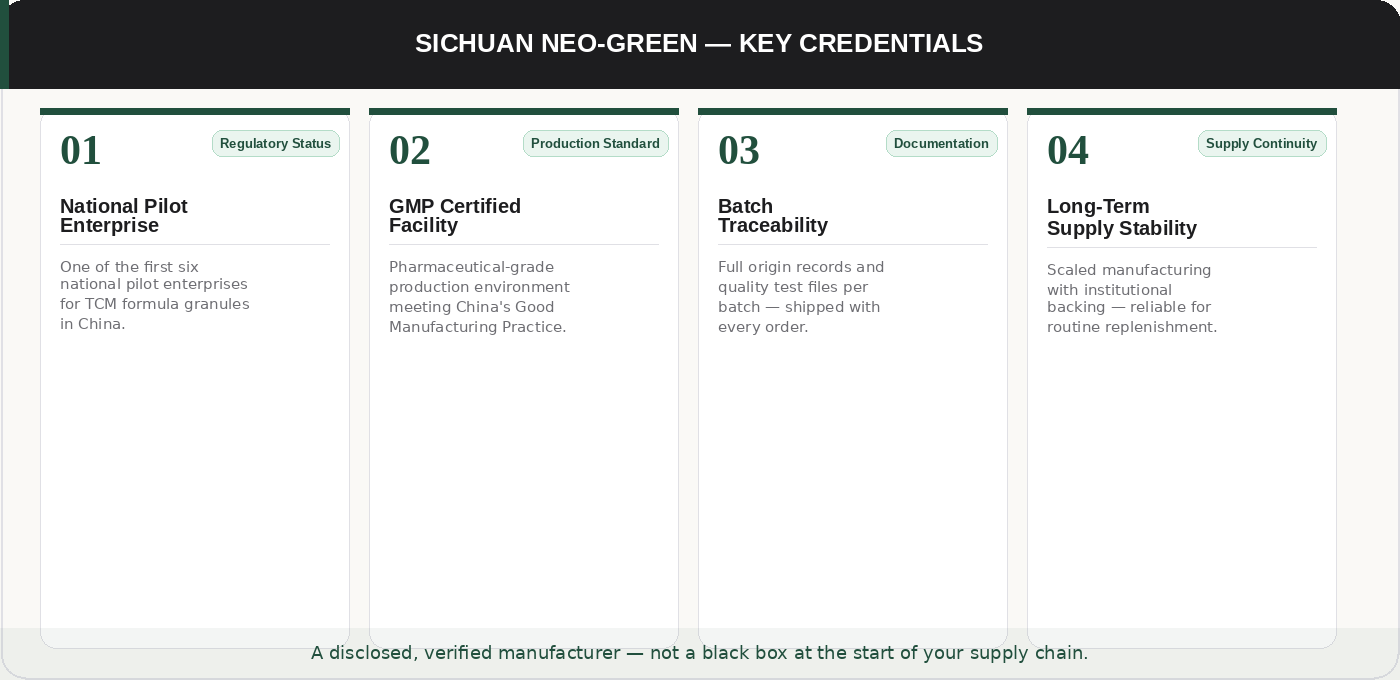
National Pilot Enterprise Status
China's national pilot program for TCM formula granules was established to develop and standardize what had previously been a fragmented and inconsistently regulated product category. The program designated a small group of enterprises — initially six — to operate under heightened regulatory oversight while the broader standards framework was developed.
Neo-Green was among those original six enterprises. This is not a marketing designation. It reflects decades of production under direct regulatory scrutiny, participation in standard-setting processes, and a compliance track record that predates the broader certification of the category.
For clinics, this translates to one specific assurance: the production standards behind these granules were shaped and tested under a more rigorous framework than general market entry requires.
What Batch Traceability Looks Like in Practice
One of the more concrete differences between a disclosed manufacturing source and a black-box supply chain is the documentation you can actually access.
With Neo-Green as a disclosed partner, QiGlobal can provide — per batch — the origin records for the raw materials used in that production run, the manufacturing date and batch identifier, and the quality test results before release. This documentation ships with your order. You don't need to make a formal request or wait for a response to obtain it.
The practical value of this becomes clear in specific situations: a patient asks about ingredient sourcing, a regulator conducts a routine inspection, or a quality question arises about a specific product lot. In each case, the documentation is already in hand.
In a multi-layer supply chain, batch documentation often exists somewhere — but accessing it requires working back through each intermediary. By the time a request reaches the original manufacturer and the response travels back, days or weeks may have passed. In practice, many clinics simply never receive the original documentation. A direct relationship with a disclosed manufacturer removes this gap entirely.
Supply Stability as a Quality Factor
Manufacturing quality isn't only about what happens inside the production facility. It's also about whether production can be sustained consistently over time — whether raw material sourcing is stable, whether the manufacturing workforce is experienced, and whether the enterprise has the institutional backing to invest in maintaining standards.
Neo-Green's scale and regulatory history provide a specific kind of assurance here. The production environment that exists today has been built and maintained over years, not assembled quickly for market entry. For clinics planning routine inventory replenishment, this continuity is a material factor — not just a credential to display.
What This Means for Your Sourcing Decision
Understanding a manufacturing partner's credentials doesn't change what you order. It changes what you know about what you're ordering — and what you can demonstrate to others when asked.
The shift from an anonymous supply chain to a disclosed one isn't primarily about getting better herbs. It's about operating with the kind of documented assurance that belongs in any serious clinical environment. GMP certification is the baseline. A national pilot designation, long-term compliance history, and per-batch documentation are the specifics that make that assurance meaningful in practice.
The core point
GMP certification is a regulatory floor, not a complete quality story. What distinguishes Neo-Green is its position as one of China's original TCM granule pilot enterprises — a status that reflects decades of heightened regulatory scrutiny, not just initial certification.
For clinics, the practical outputs are concrete: per-batch documentation, a disclosed manufacturing source, and supply continuity backed by institutional scale. These are the specifics that make "GMP certified" a meaningful claim rather than a label.
Ready to order more clearly?
If your clinic values traceability and planned restocking, Direct2Factory is designed for that workflow.
Start Ordering →