
If you run a TCM clinic or manage its purchasing, you probably open a supplier system every few weeks, browse products, confirm prices, and place an order. The routine is so familiar it barely requires thought.
But there's a question most practitioners have never seriously asked:
Where do these herbal granules actually come from — and how many hands did they pass through to get here?
This isn't a cynical question. It has direct implications for the price you pay, the documentation you can access, and how far back you can trace a product when quality questions arise.
The Traditional Supply Chain: A System Most Clinics Never See in Full
In most TCM supply markets, there are typically three to four layers between the manufacturer and the clinic. Each layer exists for a reason — distributors absorb inventory risk, brand packagers handle localization, regional agents provide last-mile service. But this structure produces some predictable side effects:
- Every layer adds margin. The price a clinic pays already includes multiple rounds of markup stacked on top of each other.
- Information thins out at each handoff. By the time a product reaches the clinic, the manufacturer's name, batch origin, and test records are often missing or unavailable without a formal request.
- When quality issues arise, the trail gets complicated. The more layers involved, the longer the traceability chain — and the weaker the clinic's position when accountability is needed.
Two Models, Side by Side
The difference becomes clear when you lay both structures out directly. Traditional supply runs through four layers — factory, distributor, brand repackager, then clinic — with margin added at each step and information diluting at every handoff. The QiGlobal Factory2Clinic model runs through two: factory, QiGlobal, clinic. The manufacturer is disclosed, and batch documentation ships with every order.
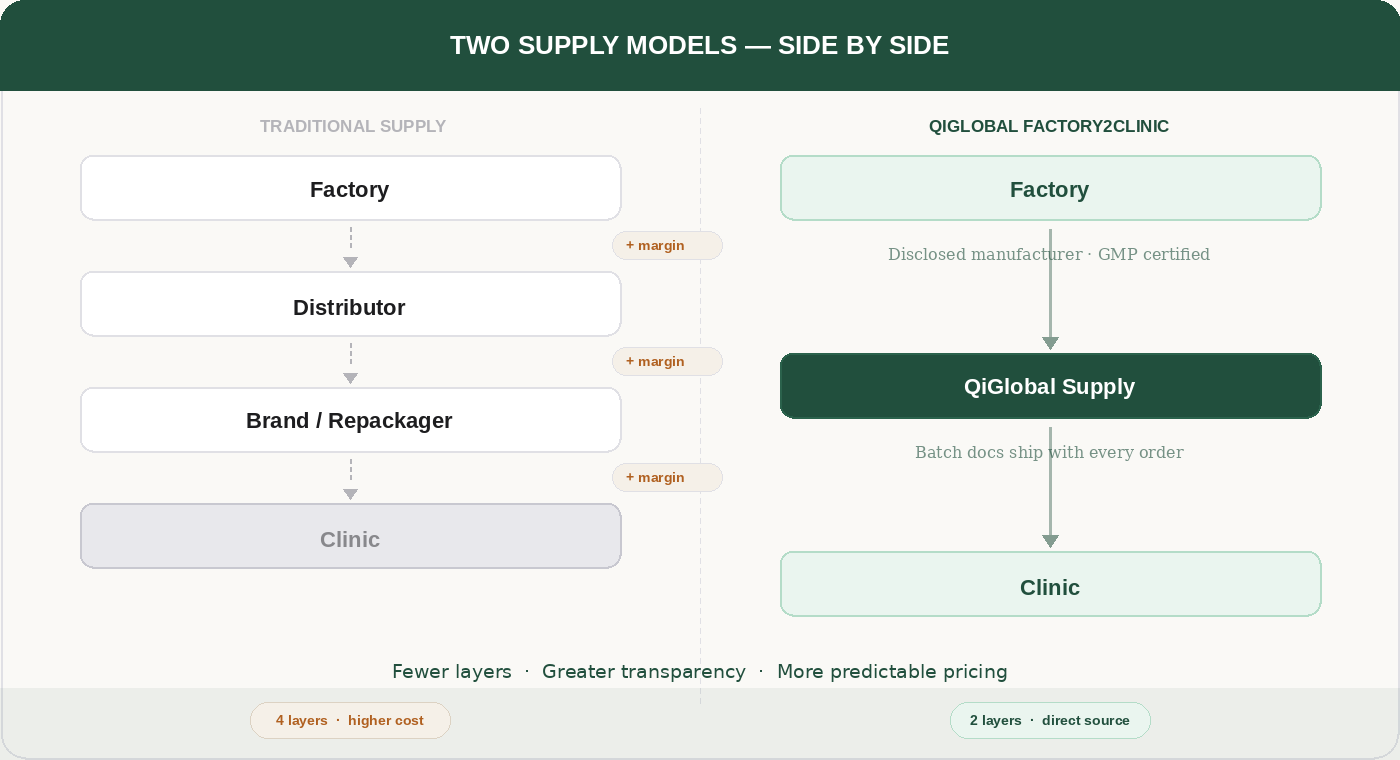
Fewer layers doesn't mean faster. It means the supply chain becomes something that can actually be verified — in price, and in origin.
What "Disclosed Source" Actually Means
In the QiGlobal model, the manufacturing partner is public information, not internal data. QiGlobal Supply works with Sichuan Neo-Green Pharmaceutical Technology Development Co., Ltd. — one of the first six national pilot enterprises for TCM formula granules in China, operating under GMP-certified standards.
This partnership reflects a deliberate choice based on three things:
- Regulatory stability. As a national pilot enterprise, Neo-Green operates within a defined regulatory framework — not a grey-zone manufacturer.
- Batch traceability. Origin records, production documentation, and quality test files are available per batch — not something you need to chase down after the fact.
- Supply continuity. A scaled, institutionally backed manufacturer offers more consistent long-term supply than a fragmented network of smaller vendors.
When a patient or regulator asks where a batch of herbs came from, being able to produce a clear manufacturer credential and batch record is both a mark of professionalism and a form of risk management. The gap between having that answer and not having it is significant in any formal context.
Transparent Pricing: Why You Pay What You Pay
Pricing in the TCM granule market can vary by 30–50% across different channels for the same product. The source of that spread isn't complicated: it's the number of layers and the margin each one takes.
In a Factory2Clinic structure, the price composition is simpler — manufacturing cost, plus QiGlobal's logistics and operations, plus a transparent margin. No additional layers to sustain. The pricing you see is easier to understand and more predictable over time.
To be clear: Factory2Clinic is not always the lowest-cost option in every scenario. Local distributors still have real advantages for small-volume or urgent orders. The cost benefit here applies specifically to planned purchasing — when your restocking needs are predictable and you have lead time to work with.
Factory2Clinic operates on a typical lead time of 35+ days. This is not a model for Friday stockouts that need to be resolved by Monday. It is designed for routine inventory management — ordering ahead, replenishing in planned cycles, and getting better pricing and sourcing assurance in return. If your clinic has urgent needs, local distributors remain the faster option.
Transparency Is Not Just a Philosophy
"Supply chain transparency" can sound like marketing language. In practice, it means something more specific:
- You can name the manufacturer and verify their credentials.
- You can produce batch documentation when asked.
- The price you pay has a clear, traceable logic.
- When quality questions arise, you know what to look for and who to contact.
These four things should be baseline expectations for any clinic taking its procurement seriously. Factory2Clinic is built to make them the default — not something you have to negotiate for.
The core point
The number of layers in a supply chain determines both pricing transparency and source traceability. Fewer layers isn't about speed — it's about giving clinics a more solid foundation for purchasing decisions.
Factory2Clinic is designed for planned, routine restocking. It isn't right for every situation. But if your clinic is thinking seriously about supply reliability and cost structure, it's worth a close look.
Ready to order more clearly?
If your clinic values traceability and planned restocking, Direct2Factory is designed for that workflow.
Start Ordering →