When people hear "factory-direct pricing," the instinct is to assume it simply means cheap. But the more accurate framing is structurally simpler — and understanding the structure is what makes the pricing predictable rather than just attractive.
This post breaks down where the cost difference actually comes from, when it applies, and what it means in practice for a clinic managing regular inventory.
How Pricing Layers Stack
In a traditional TCM granule supply chain, price is built cumulatively. Each participant adds a margin to cover their own costs and profit. The clinic sees only the final number — not the components that produced it.
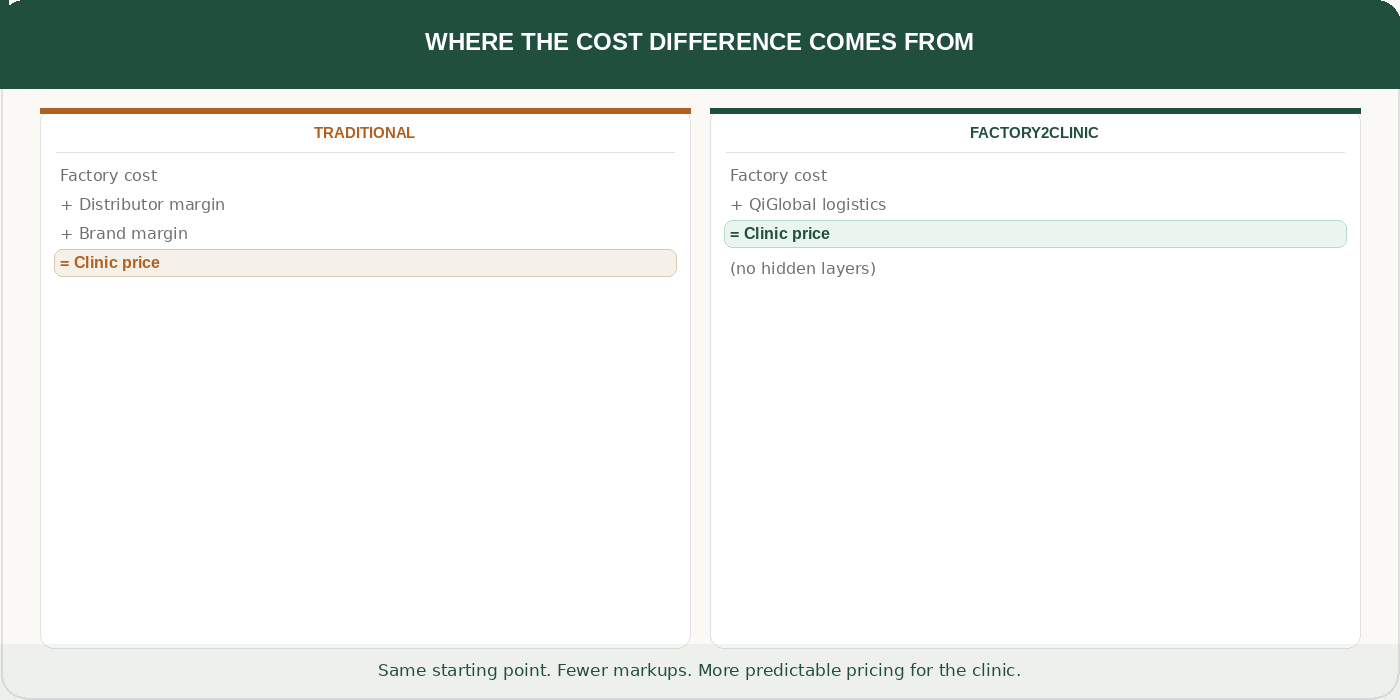
The actual percentages vary by product and supplier relationship. But the structure is consistent: every intermediary layer that exists must recover its costs through the price it passes on. Remove a layer, and that cost component is no longer in the stack.
What Factory2Clinic Pricing Actually Contains
In QiGlobal's model, the price a clinic pays covers three things:
- Manufacturing cost. The cost of producing the granules — raw materials, production labor, facility, quality testing, batch documentation.
- International logistics and import handling. Freight, customs clearance, and the operational work of moving product from factory to clinic. All-inclusive — no surprise freight invoices at delivery.
- QiGlobal's operating margin. The margin that covers sourcing, quality oversight, documentation management, and supplier relationship maintenance.
What is not in the price: distributor margin, brand repackaging costs, regional agent fees. The clinic isn't paying to sustain a distribution chain it never interacts with.
The Predictability Advantage
Lower cost is one outcome. But for clinic operations, predictable cost may matter more. In a multi-layer supply chain, prices shift for reasons the clinic has no visibility into. In a factory-direct model, the pricing inputs are more stable — manufacturing cost changes with raw materials, logistics with freight markets. Both are trackable.
Consider Huang Qi — a high-volume herb for many practices. In a traditional channel, the clinic price reflects factory cost plus a national distributor margin of 15–25%, plus a regional agent fee, plus a brand packager's margin. In factory-direct, it reflects factory cost plus logistics and one operating margin. The difference on a single bottle may be modest. Across a full restocking order, across multiple years of routine purchasing, it compounds.
When the Cost Advantage Is Real — and When It Isn't
- Planned, routine orders. The economics work best when ordering in advance in quantities that make direct sourcing efficient. Small spot orders don't generate the same benefit.
- High-velocity herbs. For herbs you stock consistently and turn over regularly, the cumulative savings across restocking cycles are meaningful.
- Adequate lead time. Factory2Clinic operates on 35+ day lead times. If ordering with sufficient runway, the cost structure works in your favor. If ordering urgently, local distributors may be the right call.
Volume Discounts Within the Model
QiGlobal's pricing includes a tiered volume discount structure — the larger the order value, the higher the discount. The tiers run from 3% at $500 product subtotal to 8% at $2,000 and above. For clinics placing regular consolidated orders, these tiers compound the base pricing advantage.
Factory-direct pricing isn't about finding the cheapest herbs. It's about paying a price that reflects what the product actually costs to make and deliver — without embedded costs from intermediary layers you don't need. For clinics that plan their purchasing, that's a meaningful operational advantage both in price and in predictability over time.
The core point
The cost difference in factory-direct sourcing comes from structure, not discounting. Each removed layer means one fewer margin applied to the price. The result is both lower and more predictable — because the inputs that drive it are more visible and stable.
The advantage is clearest for planned, routine orders of high-velocity herbs with sufficient lead time. That's the use case Factory2Clinic is built for.
Ready to order more clearly?
If your clinic values traceability and planned restocking, Direct2Factory is designed for that workflow.
Start Ordering →