
Most clinic inventory problems aren't sourcing problems. They're planning problems. The herb runs out not because it wasn't available, but because no one noticed the stock was low until the last bottle was opened.
Factory2Clinic works best for clinics that plan ahead. But planning ahead doesn't mean complex systems or significant overhead. It means three consistent practices applied to the herbs that matter most.
The Three Principles
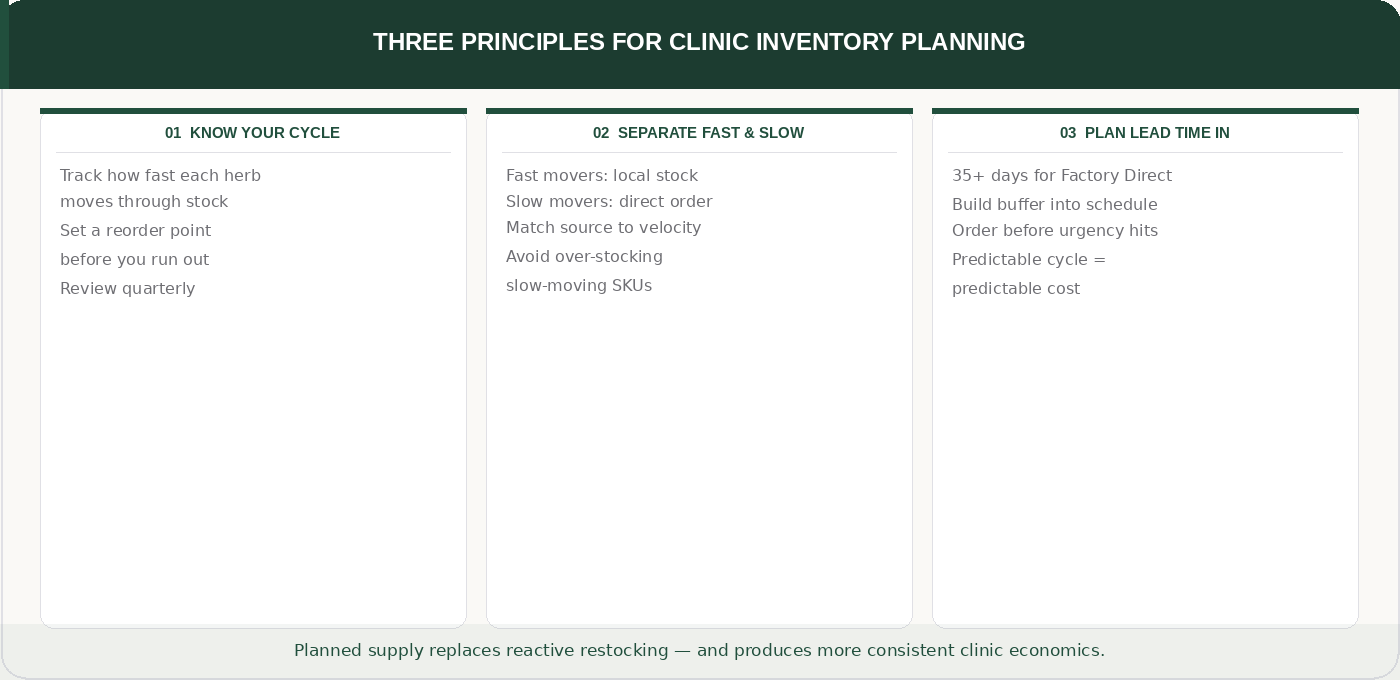
Principle 1: Know Your Cycle
For each herb you stock routinely, you need one number: how long a standard unit lasts at your clinic's typical usage rate. This is your consumption cycle.
This doesn't require sophisticated tracking. A simple log — date opened, date finished — for your top 10 or 15 herbs gives you the data you need within a few months. Once you know the cycle, you know when to reorder before running out.
- Track your top herbs first. Start with the 10–15 herbs you use most frequently. These are the ones where stockouts hurt most and where planning delivers the most value.
- Set a reorder point. Once you know your cycle, set a reorder trigger: "when stock drops to X bottles, place the order." For Factory2Clinic orders with 35+ day lead times, this trigger needs to be set well in advance.
- Review and adjust quarterly. Usage patterns shift with seasons and patient mix. A quarterly review keeps your reorder points accurate.
Principle 2: Separate Fast and Slow Movers
Not all herbs in your inventory deserve the same sourcing treatment. High-velocity herbs — the ones you use constantly — have different supply needs than slow-moving specialty herbs you might order once or twice a year.
- Fast movers: candidates for direct sourcing. If you're reordering Huang Qi every four to six weeks, it belongs in a planned Factory2Clinic order. The volume and frequency make the economics work, and having batch documentation on file for your most-used herbs is a sensible baseline practice.
- Slow movers: local or on-demand sourcing. A herb you use twice a year doesn't benefit from a factory-direct supply chain. Order it locally when you need it. Don't let it sit in direct-order planning where it adds complexity without benefit.
- Match source to velocity. The goal is a purchasing system where each herb is sourced through the channel that fits its actual usage pattern — not forced into a single approach.
Take your full herb list and sort it into two columns: herbs you reorder at least quarterly, and herbs you reorder less often. The first column is your Factory2Clinic candidate list. The second column stays with your local distributor. This single exercise often reveals that 20–30% of herbs by item count represent 70–80% of total usage volume — and those are the herbs where planned direct sourcing pays off.
Principle 3: Plan Lead Time Into Your Calendar
The most common reason factory-direct sourcing fails to deliver its benefits isn't price or quality. It's that clinics underestimate how much advance notice they need to build into their purchasing calendar.
Factory2Clinic operates on a 35+ day lead time. That means if you want herbs to arrive by a certain date, the order needs to be placed five to six weeks before that date — not when you notice you're running low.
- Work backwards from when you need it. If you run a quarterly restocking cycle, identify the date herbs need to arrive, then count back 40 days. That's your order date. Put it in the calendar before the quarter starts.
- Build a buffer. Usage patterns are variable. A buffer of two to three weeks beyond the minimum stock level means a delay in production or shipping doesn't produce a stockout.
- Order before urgency hits. The moment restocking feels urgent, factory-direct is no longer the right tool. The discipline of planning is what keeps the lead time from becoming a problem.
What Changes When You Plan
Clinics that move from reactive to planned inventory management typically notice three things: fewer stockouts of core herbs, more consistent per-unit costs over time, and less decision-making overhead in the moment of restocking — because the decision was already made at the start of the planning cycle.
None of this requires purchasing software or complex spreadsheets. It requires knowing your top herbs, knowing their cycles, and building order dates into your calendar before you need them.
The core point
Factory2Clinic works best when clinics plan for it. The three principles — know your cycle, separate fast and slow movers, plan lead time in — are the habits that make planned supply viable in practice.
Start with your top 10 herbs. Track one cycle. Set one reorder point. The system builds from there.
Ready to order more clearly?
If your clinic values traceability and planned restocking, Direct2Factory is designed for that workflow.
Start Ordering →