
Most supply chain conversations default to "which model is better?" That's the wrong question. The more useful question is: which model fits this specific purchase — this herb, this quantity, this timeline, this use pattern?
Factory2Clinic and local distribution aren't competing for the same jobs. They're suited to different ones. This post lays out the distinction directly.
What Factory Direct Does Well
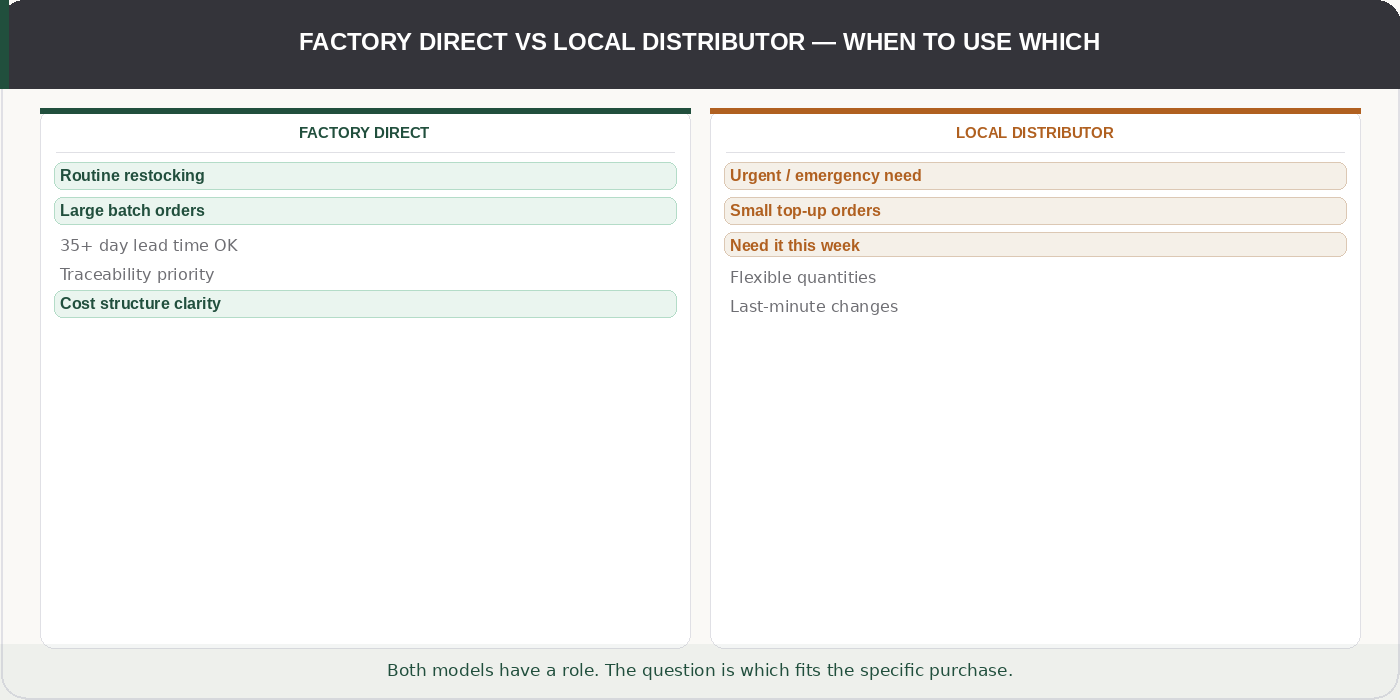
Factory2Clinic is built for a specific purchasing profile. It delivers its clearest value when:
- You're restocking, not filling an emergency. The model requires 35+ day lead time. If you have runway, that's not a constraint. If you don't, it is.
- The order is large enough to consolidate efficiently. Direct sourcing works best with meaningful batch sizes. Small top-up orders don't realize the cost advantage in the same way.
- Traceability documentation matters to your practice. Batch records, GMP certification details, manufacturer credentials — these ship with every Factory2Clinic order. If your clinic needs to demonstrate sourcing quality, this is where the direct model earns its keep.
- You want pricing you can plan around. Direct-sourced pricing follows a predictable logic. For clinics building multi-month purchasing plans, that stability has operational value.
- The herbs are high-velocity items in your stock. For herbs you reorder on a regular cycle, the economics of direct sourcing compound over time.
What Local Distributors Still Do Better
Local distribution has genuine advantages that factory-direct doesn't match in every scenario:
- Speed. A local distributor can often fulfill an order in days. When a clinic runs short on a critical herb mid-week, that responsiveness has real value that no lead-time calculation can replace.
- Small quantities without minimum order pressure. Ordering two or three bottles of a slow-moving herb? Local distribution handles that without the overhead of a consolidated international shipment.
- Variety and flexibility. Local distributors often stock a wider range of products and can respond to requests for unusual or lower-volume items that may not be efficiently sourced direct.
- Relationship and service. An established distributor relationship offers responsiveness to account-specific needs — substitutions, credit terms, returns — that a factory-direct model doesn't replicate.
QiGlobal built Factory2Clinic for planned, traceability-focused, cost-efficient restocking of core clinic inventory. We're direct about the 35+ day lead time because it matters. Clinics that try to use a factory-direct model for urgent needs will be disappointed. Clinics that use it for what it's designed for will find it performs exactly as described.
A Practical Framework for Deciding
When a restocking need arises, three questions determine which model fits:
- How much lead time do I have? More than five weeks: factory-direct is viable. Less than two weeks: local distribution is the right call. Between two and five weeks: depends on urgency and the specific herb.
- Is this a core inventory herb or a fill-in item? Core inventory herbs — the ones you always stock, always reorder — are natural candidates for direct sourcing. Fill-in items and occasional-use herbs are better handled locally.
- Does documentation matter for this purchase? If you're making a compliance-sensitive purchase, or if a patient has asked about sourcing quality, the batch documentation that comes with factory-direct sourcing is a material advantage.
Building a Hybrid Approach
Most well-run clinics don't choose one model exclusively. They route different purchases to different sources based on what each purchase actually needs. The practical outcome is something like:
- Core, high-velocity herbs: Factory2Clinic on a planned cycle, consolidated quarterly or biannually.
- Secondary herbs and variable-volume items: local distributor on a responsive basis.
- Emergency and urgent needs: local distributor, always.
This isn't a compromise — it's an optimized approach. Each source does what it does well.
The core point
Factory direct and local distribution serve different purchasing scenarios. Factory2Clinic is the right choice when you have lead time, are ordering core inventory herbs in meaningful quantities, and value transparent pricing and traceability documentation.
Local distribution is the right choice when you need speed, flexibility, or small quantities. The goal is matching the model to the purchase — not picking one and applying it to everything.
Ready to order more clearly?
If your clinic values traceability and planned restocking, Direct2Factory is designed for that workflow.
Start Ordering →